
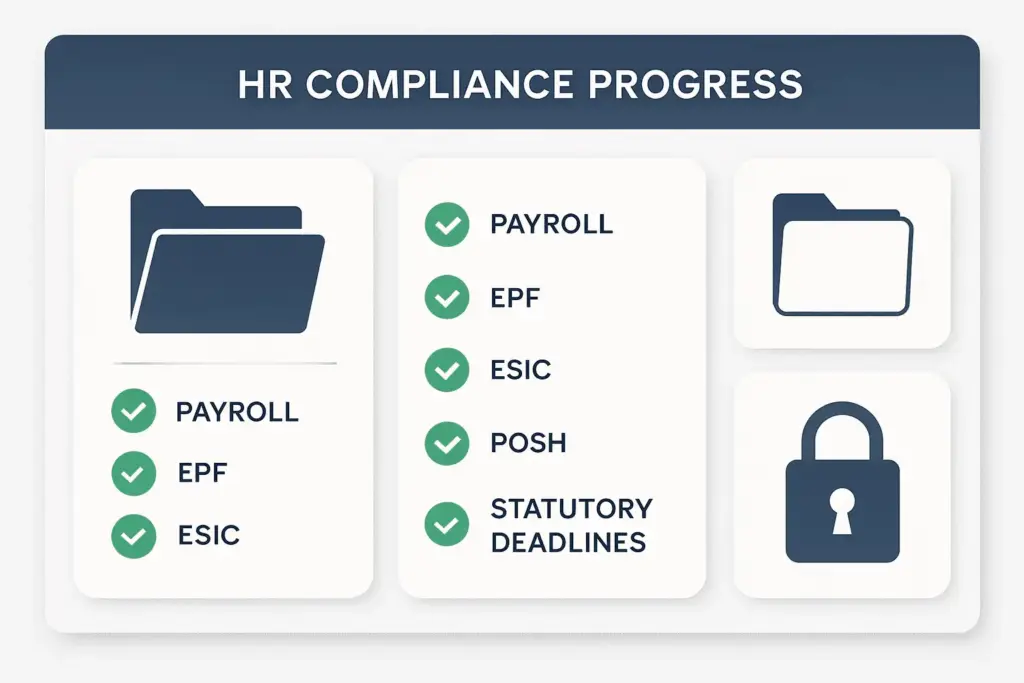
This is the HR compliance checklist an Indian company under about 300 people actually needs. Seven areas, each with the specific thing to check rather than a category name.
One piece of context before the list. India replaced twenty-nine central labour laws with four Labour Codes on 21 November 2025, with central rules notified on 8 May 2026. State rules are still being notified and are not uniform, so a checklist that does not name your states will pass a company filing in only one of four.
1. Employee documentation
Every employee file should contain a signed appointment letter with the salary structure, notice period and probation terms, acknowledged copies of your policies, PAN and Aadhaar, bank details, and the PF and ESI declarations.
Verify the UAN at joining rather than at the first filing. A wrong or missing UAN means the employee’s PF does not link to their existing account, and untangling it after six months of contributions is genuinely painful.
Store it somewhere access-controlled. Under the Digital Personal Data Protection Act, 2023 you need a purpose for the data you hold, restricted access, and a retention period. Ex-employee files sitting on an open shared drive indefinitely is the most common gap.
2. Registrations
Check each of these is current in every state where an employee actually works, not just where the company is registered:
- Shops and Establishments registration, and its renewal date
- PF (EPFO) registration, mandatory at 20 employees
- ESI registration, mandatory at 10 employees in most states
- Professional tax registration, per state
- Labour Welfare Fund, where the state operates one
Employ across four states and you have four sets of registrations and four renewal calendars. This is where manual compliance breaks first, and it breaks quietly.
3. Filings and deadlines
The recurring calendar, with the dates that changed under the Codes:
- Wages by the 7th of the following month under the Code on Wages, 2019. The concession letting employers with 1,000 or more staff pay by the 10th has been removed.
- PF and ESI contributions monthly, with damages accruing on late deposits.
- Professional tax per state, on each state’s own cycle.
- TDS monthly, with Form 16 annually.
- Final settlement within two working days of resignation, dismissal or retrenchment. Not the next payroll cycle. This one catches almost everybody.
Set reminders three working days before each deadline, because a PF challan needs money moved and someone to approve it.
4. Wages, hours and leave
- Minimum wages checked against the current notification for each state, zone and skill category. Paying last year’s rate is underpayment.
- Deductions capped at 50% of wages in any wage period.
- Equal pay, which the Code on Wages widened beyond male and female to expressly include transgender employees.
- Hours and overtime under the OSH and Working Conditions Code, 2020, read with your state Shops and Establishments Act. Several states amended theirs during 2025 and 2026, so check the current daily limit and quarterly cap per state.
- Leave configured per state, with carry-forward and encashment written down and provisioned.
5. POSH, and the policy nobody has
POSH applies at ten or more employees, regardless of whether any of them are women. The Internal Committee needs at least four members, a senior woman as Presiding Officer and one external member, with at least half the members women.
An enquiry must conclude within 90 days, the committee reports within 10 days, and the annual return goes to the District Officer by 31 January even in a year with no complaints. Penalties start at ₹50,000 and double on repeat.
The one almost everyone misses: under section 21 of the Rights of Persons with Disabilities Act, 2016, every establishment must publish an equal opportunity policy and register a copy. There is no headcount threshold at all.
6. Internal audit
Twice a year, with someone other than the person who runs payroll doing the checking. Pull actual evidence rather than assurances: challan numbers, the signed contracts, the POSH committee order with names and dates.
Sample ten personnel files at random rather than reviewing all ninety. That tells you whether the process works.
7. Records you can produce on demand
Registers and records are a statutory obligation in their own right, not just good practice. Keep attendance, wages, leave and the statutory registers in a form you can produce during an inspection, with dates attached.
Digital is fine and generally better, provided access is restricted and there is a backup. What matters is that the record existed at the time, not that it looks tidy now.
The short version
If you do only five things: name your states and register in each of them, get wages out by the 7th, constitute the POSH committee at ten employees and diarise the January return, publish the equal opportunity policy, and set a retention rule for employee data.
Then put a quarterly reminder in the calendar. An hour every three months catches most of what goes wrong, while it is still cheap to fix.
If that hour is not going to happen, our employee compliance service runs the registrations, filings and calendar across every state you employ in. Send us your headcount and locations and we will tell you what is missing.
Related compliance guides
- Statutory vs regulatory vs contractual compliance: key differences
- What is statutory compliance in HR? Meaning, examples & laws
- Penalties for statutory non-compliance in India
Every registration, monthly filing and annual return for Indian employers - in one place.
Get it free →