
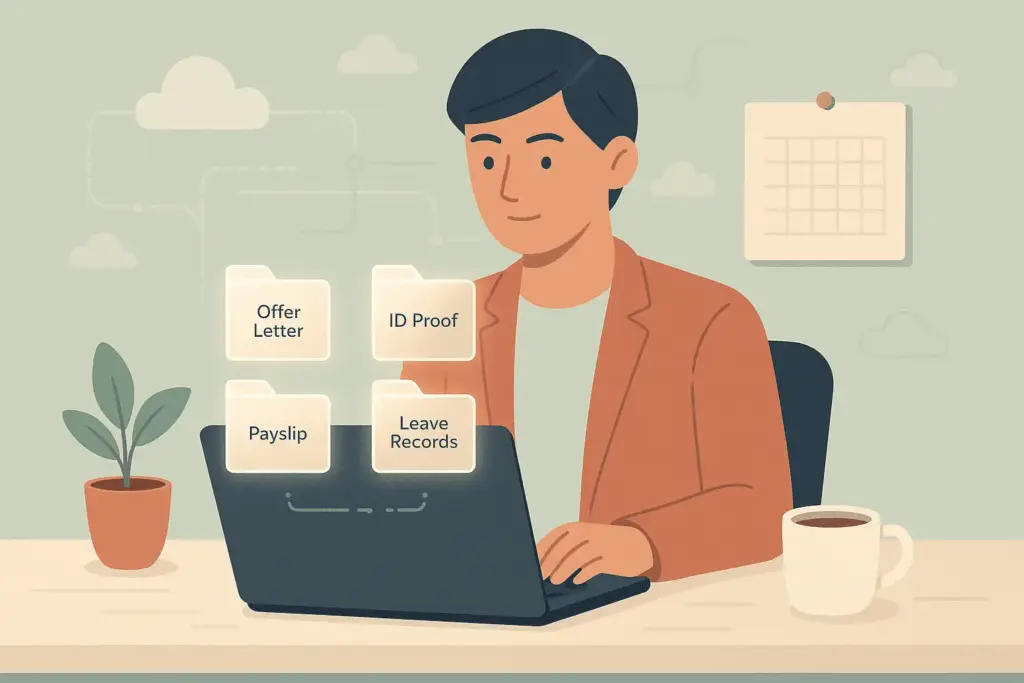
Digitising employee documentation converts paper files, scanned PDFs and folder-based records into a searchable, audit-ready HRMS database. Indian employers using digital documentation cut inspection response time by 80 percent, retrieve any employee record in seconds, and meet the 3 to 7 year retention rules under EPF, ESIC and Payment of Wages Acts automatically.
Digitising employee records is usually sold on convenience. The stronger argument is that paper files fail exactly when you need them: during an inspection, during a dispute, or when the person who knew the filing system has left.
There is also a legal dimension now that did not exist a few years ago, and it cuts both ways.
1. Onboarding stops waiting on paperwork
Collecting offer acceptances, ID proofs and declarations on paper means scanning, filing and chasing. Digitally it means a link sent before the joining date.
The practical gain is not speed, it is completeness. When the request goes out a week early, you find the missing certificate while there is still time to chase it, and PF and ESI registration can be filed on time rather than in the month-end rush.
Verify the UAN at joining while you are at it. A wrong or missing UAN means the employee PF does not link to their existing account, and untangling that after six months of contributions is genuinely painful.
2. You can actually produce records when asked
Statutory registers and employee records are an obligation in their own right, not just good practice, and the test is whether you can produce them.
Digital records win here for a dull reason: they are searchable and they have dates attached. During a PF or ESI inspection, or in a dispute over a termination, what matters is showing what existed at the time. A cupboard cannot demonstrate that.
The same applies to a disciplinary process. Under the Industrial Relations Code, 2020, an enquiry into suspended misconduct must be completed within 90 days, and dismissal without a valid enquiry is the most common reason an Indian termination is set aside. Dated records are how you show the process happened.
3. Access control, which is now a legal duty
This is where digitising can make things worse rather than better, and it is worth being blunt about.
A locked cupboard has one key. A shared drive that “everyone in the office” can open is not an improvement, it is a wider exposure of Aadhaar numbers, PAN, bank details and salary history.
Under the Digital Personal Data Protection Act, 2023 you are expected to hold employee data for a stated purpose, restrict access to it, keep it secure, and not keep it indefinitely. Digitising without setting permissions and a retention period moves you backwards against all four.
So do it in this order: decide who needs access to what, set the permissions, write the retention rule, then scan.
4. You can answer questions with the records
Once records are structured you can see patterns rather than anecdotes: which team has the most unplanned absence, how much accrued leave you are carrying as a liability, where documentation is consistently incomplete.
That leave figure surprises people. Accrued leave is money you owe, and most small companies have never put a number on it until someone senior resigns.
5. It works when nobody is in the office
Obvious since 2020, but with a specific Indian consequence. Remote and hybrid working means employees in states where you have no office, and their statutory settings follow where they actually work rather than where you are registered.
If the employee file records only a head-office location, you will not notice that someone moved and has been on the wrong professional tax slab since.
The cost argument, honestly
Saving on cabinets and printing is real but small. The saving that matters is the hours spent looking for things, and the cost avoided when a record exists that otherwise would not have.
Neither shows up cleanly on a spreadsheet, which is why this gets deprioritised.
How to do it without creating a new problem
- Set permissions before you scan. Decide who sees payroll data, who sees personal documents, and who sees neither.
- Write a retention rule for ex-employee records and actually apply it. This is the gap almost every SME has.
- Start with new joiners, then work backwards through active employees. Digitising fifteen years of leavers first is how these projects stall.
- Keep the statutory registers in a form you can produce, with dates.
- Check where it is hosted and who can access it if a vendor is involved. You remain accountable for the data even when someone else processes it.
We handle employee documentation as part of our HR service, including onboarding collection and statutory registers, with a Cloud HRMS included. See how it works, or tell us how your records are kept today.
Frequently Asked Questions
Why digitize employee documentation?
Instant retrieval during audits, single source of truth, reduced paper handling, faster onboarding (offer letters and NDAs signed digitally), and statutory compliance (some registers are now portal-only). The audit trail alone justifies the switch for most companies above 25 employees.
Which employee documents are legally required in India?
Appointment letters, wage slips, attendance and leave registers, PF and ESIC records, Form 16 and TDS statements, gratuity and bonus records, and POSH IC records where applicable. Retention periods run from 3 to 8 years depending on the record.
What are the risks of digitizing employee documentation?
Data breach exposure under the DPDP Act 2023, vendor lock-in, and loss of physical originals that regulators may still ask for. Mitigations: encryption at rest, role-based access, vendor exit clauses, and one-off scanning of signed originals held in a secure archive.
How do you start digitizing employee documentation?
Inventory what you hold today, categorise by retention period and access level, pick a document management or HRMS with audit logs, migrate current employees first, and set a policy that no new document leaves paper form.
A ready-to-edit employee handbook for Indian SMEs - aligned to the 4 Labour Codes.
Get it free →