
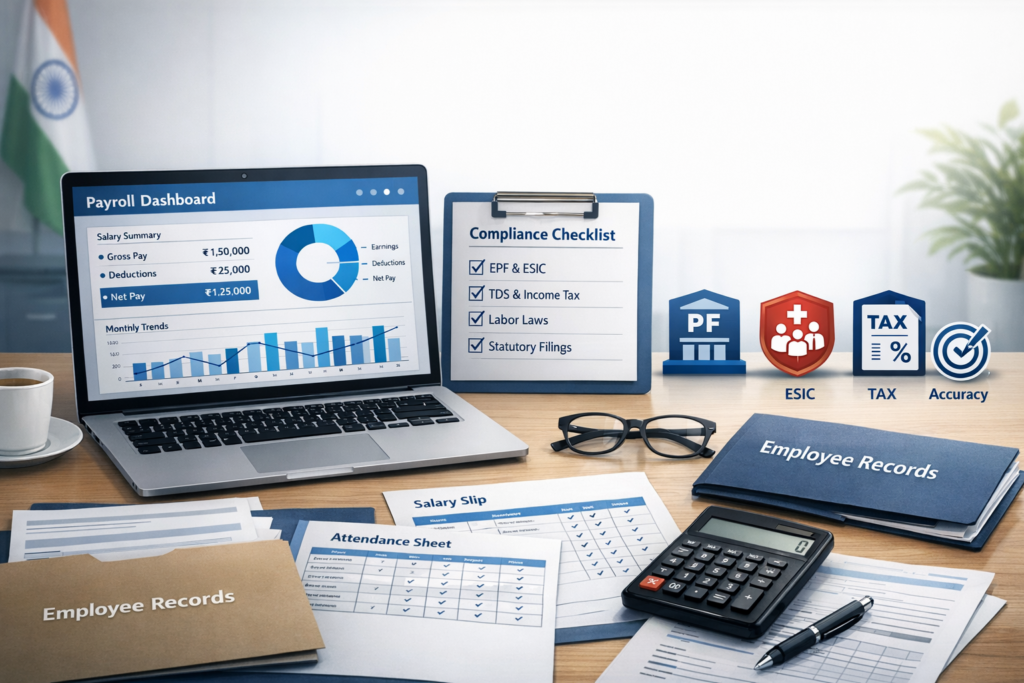
A payroll compliance audit in India checks that PF, ESIC, Professional Tax, LWF, TDS and gratuity have been calculated correctly, deposited on time, and reported in the right forms. Run it quarterly with a 20-point checklist to catch gaps worth 5 to 25 percent damages under Section 14B before an EPFO inspector does.
A Payroll compliance audit India process helps businesses check whether payroll is accurate, legally compliant, and supported by proper records. For growing companies, payroll is not just about paying salaries on time. It also includes statutory deductions, wage structure checks, employee records, and monthly filing discipline. A strong audit process reduces errors, avoids penalties, and improves internal control.
Why payroll audits matter for employers
Payroll mistakes can create serious issues. Even a small mismatch in salary structure, attendance, PF contribution, or ESIC deduction can lead to compliance gaps. That is why a Payroll compliance audit India framework should be part of regular HR operations, not just something done during inspections or year-end reviews.
A payroll audit helps employers confirm that salary data matches employee records, statutory deductions are correct, and payroll documents are ready when needed. It also improves confidence in payroll reporting and prevents avoidable disputes.
1. Check salary structure and pay components
The first step in any payroll audit is reviewing salary structure. Employers should verify whether basic pay, allowances, bonuses, deductions, and reimbursements are correctly classified. A weak or inconsistent structure often leads to compliance errors later.
This is especially important because salary structure design directly affects payroll accuracy and statutory calculations. HRTailor’s payroll and salary structure pages also highlight compliant payroll setup, salary structuring, and statutory accuracy as key parts of payroll management.
2. Verify PF, ESIC, and other statutory deductions
A good Payroll compliance audit India checklist must include PF, ESIC, professional tax, labour welfare fund, and any other applicable deductions. Employers should confirm that employee and employer contributions are calculated correctly and deposited on time.
It is also useful to check whether the payroll team is maintaining deduction records month by month. Missing proofs, incorrect calculations, or delayed filings can quickly turn into larger compliance problems. HRTailor’s service pages emphasize payroll outsourcing, statutory compliance support, and monthly compliance handling for businesses that want a more structured process.
3. Review attendance, leave, and payroll inputs
Payroll accuracy depends on input accuracy. Attendance, leave balances, overtime, loss of pay, and joining or exit dates should all be reviewed before payroll is processed. If the source data is wrong, salary outputs will also be wrong.
This is why employers should audit not only payroll reports but also the systems feeding payroll. HRTailor’s HRMS and monthly HR support pages describe attendance tracking, payroll setup, employee self-service, and process automation as part of smoother HR operations.
4. Keep employee records and documents updated
Another important area in a Payroll compliance audit India review is documentation. Employers should check appointment letters, salary revision records, bank details, tax declarations, reimbursement proofs, and exit records. In many cases, the payroll issue is not the calculation itself but the lack of supporting documentation.
Audit readiness improves when every payroll change is linked to a clear approval or employee record. HRTailor’s HR setup and monthly HR solutions pages also focus on employee documentation, policies, payroll compliance, and audit-friendly HR processes.
5. Reconcile monthly filings and payroll reports
A payroll audit should also compare payroll registers with statutory filings and payment records. Employers should check whether payroll summaries match PF and ESIC returns, payslips, and internal finance records. This step is essential for catching silent errors that may go unnoticed during a normal payroll run.
When businesses do this regularly, they can detect issues early instead of fixing months of backlog at once. A practical Payroll compliance audit India process should therefore include a monthly reconciliation routine.
6. Build an audit-ready payroll system
The best way to reduce payroll risk is to create a repeatable monthly process. Use standard checklists, approval trails, documented salary changes, and organised digital records. Payroll should not depend on memory or scattered spreadsheets.
Businesses that combine payroll, compliance tracking, attendance data, and employee documentation in one workflow usually find audits much easier to manage. HRTailor presents this kind of support through payroll outsourcing, HRMS setup, compliance management, attendance workflows, and HR setup services for growing businesses.
Conclusion
A strong Payroll compliance audit India process helps employers stay accurate, compliant, and inspection-ready. It reduces payroll errors, improves statutory discipline, and creates better control over employee records and monthly filings. For businesses looking to simplify payroll operations, compliance tracking, HRMS setup, attendance management, and employee documentation, HRTailor can be a practical support partner in building a more organised and audit-ready HR process.
FAQs
It helps employers avoid payroll errors, penalties, and compliance gaps.
It includes salary structure, PF, ESIC, attendance, leave, records, and statutory filings.
Businesses should review payroll compliance every month and conduct detailed audits regularly.
Yes, PF and ESIC checks are an important part of payroll compliance audits.
Related HRTailor services
- Payroll outsourcing in India
- Top 10 payroll outsourcing companies in India (2026)
- Statutory compliance services
Build a Labour-Codes-compliant salary structure in minutes - Basic, HRA, PF, ESIC and take-home, auto-calculated.
Get it free →