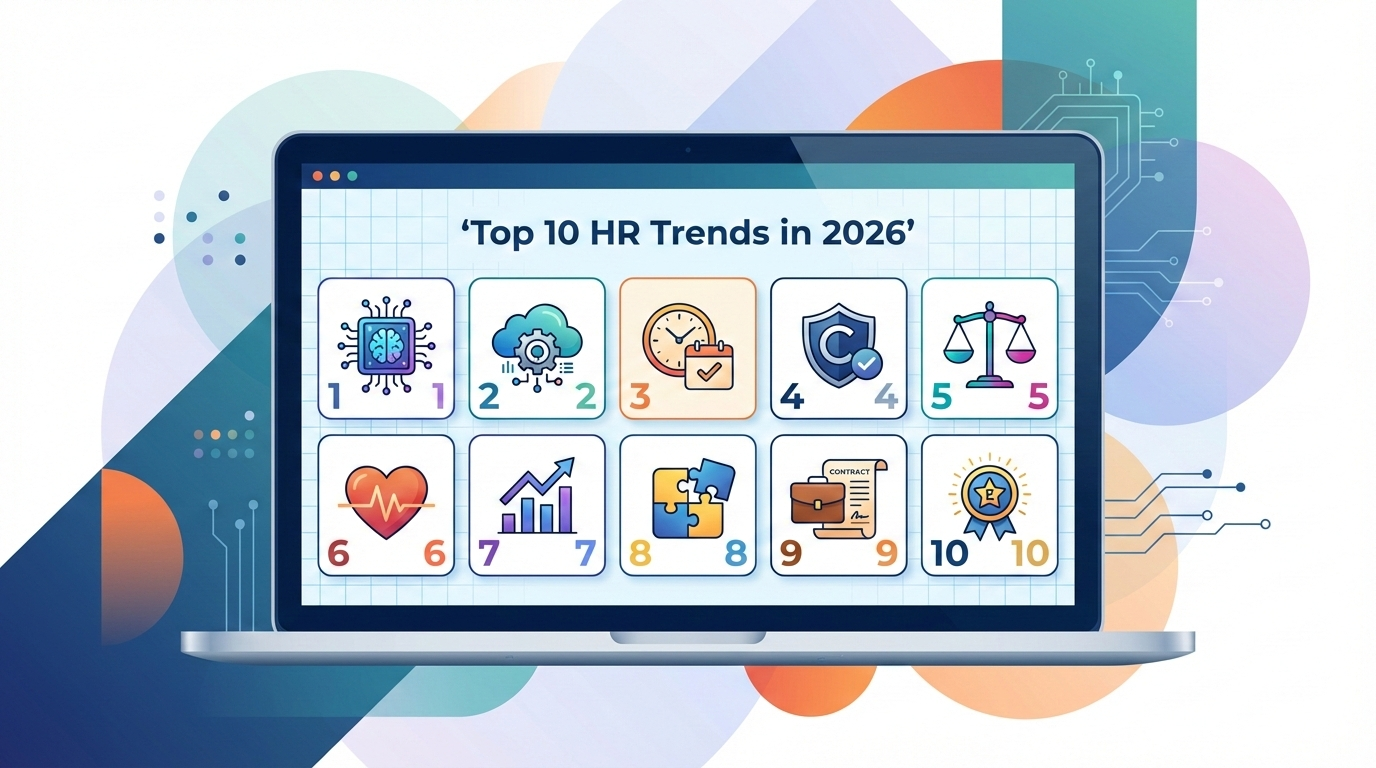
Top 10 HR Trends Companies Should Know in 2026
HR is no longer just about filling positions and processing payroll. In 2026, HR sits at the centre of strategy, law, technology and culture. Indian companies are trying to grow with leaner teams, meet stricter labour expectations and still keep employees engaged in a noisy job market.
Because of this, HR leaders and founders need a clear view of what is changing. They don’t have time to read every report, yet they need to know which shifts really matter. Below are the Top 10 HR Trends you should pay attention to in 2026, explained in simple, India-aware language.
Why 2026 Is a Turning Point for HR
The year is important not because of a single law or technology, but because three forces are converging:
- Business pressure to deliver more with fewer people
- Labour law changes that demand better structure and fairness
- Rapid growth in HR technology, AI and data
Together, these forces mean HR can no longer be purely transactional. It has to become more strategic, more informed and more integrated into business decisions.
Trend 1: Skills-First, Not Role-First Talent Strategy
Instead of hiring only based on job titles and past designations, companies are starting to look at skills and capabilities more seriously. Roles are becoming broader and more flexible, especially in startups and fast-moving sectors.
This trend means HR needs to:
- Map which skills exist in the workforce today
- Identify critical skills for the next 2–3 years
- Create internal movement opportunities, so people can shift roles instead of quitting
In India, where reskilling and internal growth can be more cost-effective than constant external hiring, this change is especially important.
Trend 2: AI and Automation Across the HR Lifecycle
Automation is touching almost every HR process:
- Screening CVs and shortlisting candidates
- Scheduling interviews and sending reminders
- Generating standard letters and emails
- Processing attendance and salary calculations
AI tools can save time and reduce manual errors. However, HR still needs to check outputs, prevent bias and ensure that candidates and employees are treated fairly and respectfully. Tech should support people, not replace thinking.
Trend 3: Hybrid and Flexible Work, But With Clear Rules
Remote work will not disappear, and fully on-site work will not disappear either. Most organisations will sit somewhere in between, with:
- Some roles fully on-site
- Some roles hybrid
- Some roles fully remote or field-based
The trend for 2026 is not “remote versus office”; it is clarity. HR policies must define:
- Which roles get which kind of flexibility and why
- How performance is measured in each arrangement
- How meetings, availability and communication should work
Clarity avoids resentment between teams and makes expectations transparent.
Trend 4: Well-Being, Mental Health and Workload Management
Employees are increasingly open about stress and burnout. Companies are realising that pushing people into long hours with vague expectations leads to mistakes, conflict and turnover.
At the same time, labour expectations around working hours, overtime and rest are getting stronger. Therefore, HR is starting to:
- Monitor workloads and overtime more closely
- Encourage realistic staffing for projects
- Provide access to basic mental health support where possible
- Train managers to recognise and handle signs of burnout
Well-being is slowly shifting from “nice-to-have” to a risk and performance topic.
Trend 5: DEI (Diversity, Equity & Inclusion) as Everyday Practice
DEI is no longer just a slide in a presentation. In 2026, it increasingly shows up in:
- How job descriptions are written
- Who gets promoted
- How harassment or misconduct is handled
- How women, LGBTQ+ staff and people from different backgrounds are treated day to day
Stronger rules around women’s safety, night shifts, PoSH, equal opportunities and grievance mechanisms also push companies to take these aspects seriously. DEI is slowly becoming part of how organisations reduce risk and protect their brand, not just a moral statement.
Trend 6: Data-Driven HR and People Analytics
HR leaders are under pressure to justify decisions with more than gut feeling. As HR systems and HRMS tools improve, HR can see:
- Where hiring funnel drop-offs happen
- Which teams have highest overtime or attrition
- Which roles are hardest to fill and keep
- How engagement and performance trends move over time
In 2026, basic people analytics will become standard, not advanced. However, the value will come from asking the right questions and translating trends into changes in policy or practice.
Trend 7: Labour Law and Wage Code Compliance as Core HR Work
In India, labour law changes are not just legal details. They directly affect:
- How salary structures are designed (for example, higher basic pay share)
- When salaries are paid (on or before the 7th)
- How overtime is paid (double pay beyond certain limits)
- When gratuity becomes due
- How quickly full & final settlements must be completed
- How different worker categories are documented and covered under social security
Because of this, HR is expected to understand the practical impact of legal changes and coordinate with finance, leadership and operations so that:
- Policies get updated
- HRMS and payroll reflect new rules
- Employees are clearly informed about their rights and benefits
This trend makes HR a key partner in risk management.
Trend 8: Gig Talent, Contractors and Blended Workforces
Many companies now rely on a mix of:
- Permanent staff
- Fixed-term employees
- Freelancers and consultants
- Gig and platform workers
This “blended workforce” gives flexibility but adds complexity. HR must handle:
- Different documentation and appointment/engagement letters
- Different benefit and social security expectations
- Clear communication about working conditions, safety and grievance options
New thinking around social protection for gig and platform workers means HR can’t completely ignore this segment anymore, even if they are not on the permanent rolls.
Trend 9: Employee Experience and Employer Brand
Employees do not judge an organisation only by its website or salary. They judge it by their experience across the entire journey:
- The clarity of the job posting and hiring process
- The quality of onboarding and induction
- How HR responds when they ask questions
- How performance and feedback are handled
- How exits and full & final settlements are managed
Companies that design these touchpoints carefully build strong reputations and find it easier to hire. Those that treat people roughly at any stage may face negative word of mouth and higher hiring costs in the long run.
Trend 10: Continuous Learning and Future Skills
Finally, skill requirements are changing too quickly for one-time training. Companies are moving towards:
- Short, targeted learning modules rather than long generic programs
- Learning integrated into work (shadowing, projects, mentoring)
- Encouraging employees to own their development with support from the organisation
HR needs to identify which skills are becoming critical, encourage people to build them and align learning with actual roles instead of running training only for formality or “budget utilisation”.
What HR Leaders Should Do With These Trends
Knowing trends is useful only if it leads to action. HR leaders and founders can:
- Pick 3–4 trends that are most relevant for their business in 2026 (for example, compliance, data, DEI and learning).
- Assess where they are today using simple questions and basic metrics.
- Update policies, processes and HRMS configurations to align with legal and strategic needs.
- Communicate changes clearly to managers and employees.
Small but consistent steps, taken now, will matter more than a big strategy deck created and then forgotten.
Conclusion
The Top 10 HR Trends companies should know in 2026 are not just buzzwords for presentations. They are the patterns already visible in how talent behaves, how laws evolve and how technology is adopted. When HR teams take these shifts seriously and turn them into practical changes in policy, process and behaviour, they help their businesses stay safer, more attractive to talent and better prepared for uncertainty.
If internal resources are limited, external HR partners such as HRTailor can support with structured policies, HRMS-backed processes and compliant HR operations, while the organisation focuses on culture and performance.
FAQs
Some of the key shifts include skills-first hiring, increased use of AI in HR, hybrid and flexible work, stronger focus on well-being and DEI, data-driven decisions, changes in labour law compliance and the rise of blended workforces.
Because these trends affect their ability to attract and keep talent, manage risk, stay compliant and control costs. Ignoring them can lead to higher attrition, penalties or reputational damage.
Technology is automating repetitive tasks like screening, scheduling, attendance and payroll. As a result, HR teams can spend more time on strategy, problem-solving and employee support—if systems are set up correctly and monitored.
Labour laws influence how you structure pay, handle overtime, design benefits, document workers and process exits. Therefore, HR strategy must incorporate these rules so that the company is fair, compliant and financially prepared.
Begin with simple reports on headcount, attrition, hiring sources, overtime and exit reasons. Look for obvious patterns, discuss them with managers and adjust policies or practices accordingly. Over time, you can refine and deepen your analytics.
At least once a year, HR and leadership should step back to review major trends, check their policies and systems and decide what needs updating. Significant legal or business changes are also good moments for a focused review.
Add Your Heading Text Here

About Abhijit Divekar
Managing Director & Founder at HRTailor
Abhijit Divekar is the Managing Director and Founder of HRTailor, India's first dedicated online HR manager service for startups and SMEs. Founded in 2019, HRTailor has grown to serve over 200 clients across India, offering end-to-end HR outsourcing starting from just INR 10,000 per month. Abhijit writes about entrepreneurship, scaling business operations, and the future of HR outsourcing in India.