Workplace Conflicts Are Rising — Here’s How Modern HR Policies Are Solving Problems Before They Get Out of Hand
Tensions in teams are higher than ever. Hybrid work has blurred boundaries, messages get misread on chat, and deadlines keep getting tighter. One misunderstanding between colleagues or a careless remark in a meeting can quickly become a serious issue.
Meanwhile, HR and business leaders are dealing with a growing list of concerns: behaviour complaints, manager–team friction, silent disengagement, and sometimes even legal or reputational risk. When there is no clear way to raise and resolve issues, small conflicts quietly grow into bigger problems.
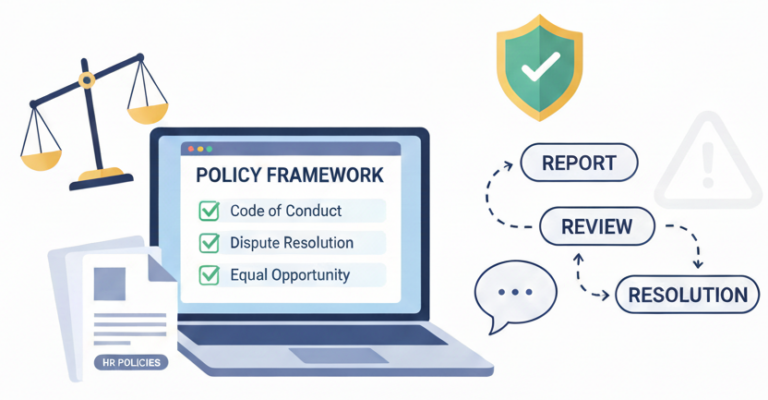
Well-designed HR Policies act like guardrails. They do not remove disagreement or pressure—that is normal in any business. Instead, they provide clarity on what is acceptable, how issues are handled, and what support people can expect when something goes wrong.
This article explores how modern, practical policies can reduce conflict, protect culture, and help companies solve problems early—before they damage trust, productivity, and brand.
In this article, you’ll learn:
- what “modern” people policies look like in today’s workplace
- why conflicts are rising across teams and levels
- which policy areas matter most for prevention, not just punishment
- how to build a simple, usable policy framework your managers will follow
- which metrics show whether your approach is actually working
What Are HR Policies in a Modern, Hybrid Workplace?
Traditionally, HR Policies were thick documents stored in a file or on a shared drive, pulled out only when something went wrong. However, that approach no longer works in fast-moving, hybrid organisations.
Today, effective policies are:
- simple and clear – written in plain language employees can understand
- visible and accessible – easy to find on HR platforms or employee apps
- connected to real life – using practical scenarios, not only legal jargon
- aligned with law and culture – balancing compliance with company values
A modern HR policy framework usually covers the full employee lifecycle:
- professional conduct and code of ethics
- anti-harassment and anti-discrimination
- hybrid work rules and remote etiquette
- performance and feedback expectations
- grievance and whistleblower channels
- disciplinary process and consequences
Most importantly, these documents are not just stored somewhere. They are supported by manager training, ongoing communication, HR systems, and leadership behaviour.
Why Workplace Conflicts Are Increasing
Conflicts did not suddenly appear; they have always existed. However, several trends have made them more visible and more complex.
Hybrid and Remote Work Misunderstandings
When much of communication happens on email or chat:
- tone is easy to misinterpret
- responses can be delayed, creating frustration
- some people feel “left out of the loop” or ignored
Without clear norms for meetings, availability, and communication, small misunderstandings can become personal tensions and then serious conflict.
Higher Workload and Role Ambiguity
As companies try to do more with leaner teams:
- roles blur and responsibilities overlap
- some employees feel they are doing “other people’s work”
- priorities clash between teams or functions
Without clarity on decision rights and escalation, disputes over workload and ownership are inevitable.
Evolving Expectations Around Respect and Inclusion
Employees today are more aware of:
- what respectful behaviour should look like
- their rights under laws and internal guidelines
- the impact of bias, microaggressions, and unsafe environments
Meanwhile, not all managers have kept pace with these expectations. As a result, what was once “tolerated” is now challenged—and rightly so.
Social Media, Brand, and Legal Risk
Issues that once stayed within four walls can now:
- reach social media, rating platforms, and industry networks
- trigger internal and external investigations
- impact employer brand and client relationships
Therefore, companies can no longer rely on informal handling of serious concerns. A clear, trusted policy framework is essential to keep conflicts from getting out of hand.
Modern Policy Tactics That Prevent Conflicts From Escalating
Policy is not about catching people doing something wrong. It is about setting clear expectations and pathways so conflicts can be surfaced and resolved early.
Here are key tactics that make workplace policies actually work.
1. Clear Conduct and Behaviour Guidelines With Examples
A generic “behave professionally” clause is not enough. Employees and managers need clarity on:
- what behaviours are considered unacceptable (e.g., abusive language, exclusion, repeated late responses to critical messages)
- what respectful collaboration looks like in meetings, online channels, and client interactions
- how power dynamics (manager vs. report, senior vs. junior) affect responsibility
Including short examples—good and bad—helps people understand the intent behind the rules and prevents “I didn’t know” conflicts.
2. Robust Anti-Harassment and Anti-Discrimination Frameworks
Beyond basic legal compliance, companies should:
- define unacceptable behaviour clearly, with reference to law and company values
- specify multiple reporting channels, including confidential ones
- outline timelines and steps for handling complaints
- explain the rights of both complainant and respondent
As a result, employees know they will be heard and that matters will be handled with fairness and confidentiality, rather than being ignored or quietly discouraged.
3. Structured Grievance and Conflict Escalation Pathways
Many conflicts get worse simply because nobody knows where to go. A strong policy framework:
- outlines an escalation ladder (Team Leader → HR → HR Manager → Management)
- allows employees to bypass a manager if the issue involves them
- sets clear expectations on response time and next steps
- encourages early dialogue, mediation, or facilitated conversations
Consequently, issues are less likely to sit unresolved in private chats or whisper networks and more likely to be addressed early, before they get out of hand.
4. Hybrid Work, Availability, and Communication Norms
Modern teams need ground rules for remote and hybrid work, such as:
- core working hours and meeting times across locations
- expectations for response time on email, chat, and calls
- rules for video meetings, recordings, and privacy
- how to handle urgent requests vs. non-urgent ones
Additionally, when communication rules are clear, frustration and misinterpretation reduce significantly, and “they are ignoring me” conflicts drop.
5. Consistent Performance and Feedback Framework
Conflicts often arise from:
- mismatched expectations
- surprise ratings at appraisal time
- perceptions of favouritism
A well-designed performance policy clarifies:
- how goals are set and updated
- how feedback should be given and documented
- how underperformance is identified and addressed
- how employees can challenge or seek clarity on ratings
Therefore, performance conversations feel structured rather than personal or arbitrary, reducing conflict between managers and team members.
Building a Practical HR Policy Framework (That People Actually Use)
A policy only works if people know it, understand it, and trust it. That means you need more than PDFs uploaded somewhere.
Step 1 – Map Your Risk Areas and Common Conflicts
Start by combining:
- HR data: attrition trends, performance, tenure, role criticality
- sentiment data: engagement surveys, pulse checks, HR query patterns
- manager input: “who would be very hard to replace?”
This gives you a risk map instead of guesses.
Step 2 – Simplify and Update Existing Policies
Next, review your current set:
- remove outdated or duplicate sections
- rewrite complex language into clear, plain sentences
- add real-world examples, FAQs, and simple flow diagrams where helpful
- ensure alignment with current laws, especially around harassment and data privacy
In addition, check that your guidelines reflect current ways of working—hybrid, remote, gig, contract, or project-based.
Step 3 – Embed Policies Into HR Operations and Systems
Policies should show up in:
- onboarding checklists and induction sessions
- HRMS or employee self-service portals
- performance and disciplinary workflows
- manager training and leadership offsites
With support from a partner like HRTailor, growing companies can integrate policies into HR processes, templates, and HRMS without building a large internal HR team. As a result, compliance and conflict prevention become part of daily operations rather than one-time announcements.
Step 4 – Train Managers and Make HR Approachable
Managers are the first line of defence against escalating conflicts. Therefore:
- train them on key policy areas and real scenarios
- provide cheat sheets and simple guides for handling issues
- clarify when they must escalate to HR or designated committees
At the same time, HR must be seen as accessible and neutral, not only as a “last resort”. A Dedicated Online HR Manager model, like HRTailor’s, helps employees and managers reach HR support quickly and consistently when concerns arise.
Common Policy Mistakes That Make Conflicts Worse
Sometimes policies exist but still fail to prevent damage. Here are typical mistakes to avoid.
- Policies that are too long and legalistic – Employees do not read or remember them, so they act based on assumptions and hearsay.
- Conflicting messages from leadership and policy – For example, a document says work–life balance matters, but leaders praise only those who are always online.
- No follow-through on reported issues – When complaints vanish into silence, people lose trust in the system and stop reporting.
- Inconsistent enforcement – When some people are “protected” and others are not, even strong written rules lose credibility.
- Policies that never evolve – New realities like hybrid work, instant messaging, and social platforms need updated guidance.
- No data or review of conflict trends – Without visibility on recurring issues, root causes remain unresolved and the same conflicts repeat.
Metrics to Track Whether Your Policy Framework Is Working
You do not need a complex dashboard. However, a few targeted indicators can show whether your approach is helping.
Key metrics include:
- Number and nature of reported cases – Not just volume, but categories (behaviour, manager conflict, harassment, etc.).
- Resolution time for conflicts and grievances – How long does it take from report to closure?
- Repeat incidents in the same team or with the same individual – A sign that deeper interventions are needed.
- Employee awareness scores – Simple survey questions: “Do you know how to raise a concern?” or “Do you know whom to contact?”
- Manager confidence levels – How confident are managers in handling sensitive conversations and applying policy?
- Legal and compliance incidents – Any external escalations or avoidable complaints can show gaps in prevention.
Moreover, reviewing these metrics regularly with HR and leadership helps you course-correct quickly and refine your framework before problems escalate.
Conclusion
Workplace conflicts will never disappear. People are different, pressures are real, and misunderstandings will happen. However, when your rules are unclear, outdated, or rarely used, every conflict becomes more painful than it needs to be—for employees, managers, and the organisation.
Modern HR Policies make expectations clear, create safe channels to raise concerns, and give HR and managers a structured way to respond. As a result, many issues can be resolved early, fairly, and quietly—before they damage morale, culture, or brand.
HRTailor helps companies build and run exactly this kind of policy backbone. With HR policy design and implementation, a Dedicated Online HR Manager, monthly HR operations, and HRMS support, you get both the frameworks and the day-to-day execution needed to keep conflicts under control.
If you want to move from reactive firefighting to calm, consistent handling of workplace issues, reach out to the HRTailor team and explore how we can strengthen your policies, processes, and people experience.
FAQs
Yes. Even small teams need clear guidelines on behaviour, conflict handling, and basic processes. However, policies can be simple and scalable rather than heavy and bureaucratic.
At minimum, once a year—or whenever there are major regulatory changes, shifts in work model (such as hybrid), or new conflict patterns emerging in your organisation.
There is no single area, but clear conduct guidelines, anti-harassment frameworks, and a robust grievance process are usually the most impactful starting points.
Introduce them during onboarding, run short awareness sessions, use simple language, and keep them accessible via HRMS or intranet. Additionally, use real examples and FAQs instead of only legal text.
Managers should be the first point of contact for many issues, model the rules in their own behaviour, and know when to escalate to HR. Training and support from HR are critical for this.
HRTailor can help you draft, update, and simplify policies; integrate them into HR operations and HRMS; train managers; and provide a Dedicated Online HR Manager who supports employees and leaders in applying these policies day-to-day.

About Abhijit Divekar
Managing Director & Founder at HRTailor
Abhijit Divekar is the Managing Director and Founder of HRTailor, India's first dedicated online HR manager service for startups and SMEs. Founded in 2019, HRTailor has grown to serve over 200 clients across India, offering end-to-end HR outsourcing starting from just INR 10,000 per month. Abhijit writes about entrepreneurship, scaling business operations, and the future of HR outsourcing in India.