How Outsourced HR Reduces Compliance Risk for Indian Businesses
Compliance risk doesn’t usually start with a big mistake. It starts quietly—one missed input, one delayed filing, one incomplete record. Then it grows in the background until it becomes urgent. For many Indian businesses, compliance isn’t ignored on purpose. It’s simply hard to manage while scaling.
In 2026, that’s why Outsourced HR Services in India are being used more often. Not to “escape responsibility,” but to run payroll, documentation, and compliance in a more structured way. When the system is stronger, risk is reduced naturally.
Why compliance risk rises as businesses grow
Early on, compliance feels manageable because the team is small and changes are fewer. However, headcount growth increases complexity quickly. More employees bring more salary variations, more attendance exceptions, more documentation needs, and more changes across the month.
Meanwhile, SME HR teams are usually lean. So when hiring and operations get busy, compliance tasks get pushed back. Unfortunately, deadlines don’t move. As a result, risk increases even when intentions are good.
Most compliance issues come from weak processes
Many leaders assume compliance failures happen due to lack of legal knowledge. Sometimes that’s true. However, most issues come from inconsistent execution—payroll inputs collected informally, documents stored in scattered places, and employee data that isn’t updated properly.
These gaps don’t feel serious daily. Yet over time, they create mismatches and missed steps. Then, when scrutiny happens, the business is forced into last-minute fixing.
Outsourcing helps by turning compliance into a repeatable system instead of memory-based work.
How outsourced HR adds discipline and accountability
A structured outsourced model brings clear ownership. Tasks are assigned, timelines are followed, and escalation paths exist. That clarity matters because compliance suffers when it’s unclear who is responsible.
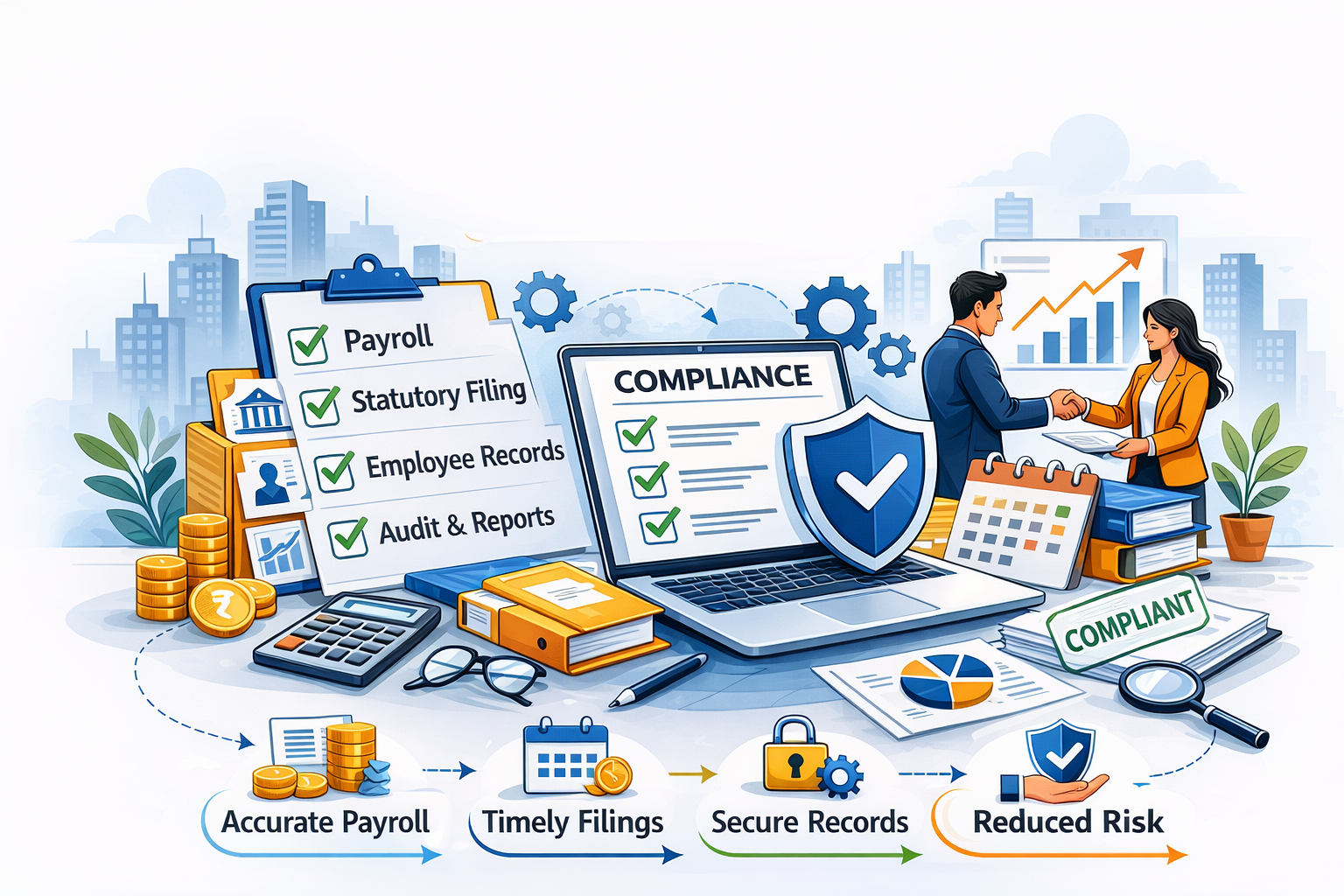
Documentation is also standardized. Templates, checklists, and workflows are used consistently during onboarding, payroll changes, and exits. Therefore, fewer gaps are created during everyday HR activity.
Instead of reacting late, the business runs on a compliance rhythm.
Payroll accuracy reduces compliance exposure
Payroll is one of the biggest compliance triggers because payroll data feeds statutory filings. When payroll is messy, compliance becomes messy too.
With outsourcing, validations are typically built into the payroll cycle. Inputs are checked, exceptions are flagged early, and approvals are recorded. As a result, fewer payroll errors turn into compliance errors.
Also, payroll documentation becomes more consistent, which helps during reviews and audits.
Cleaner employee data means fewer surprises
Compliance risk increases when employee master data is incomplete. Joining details, ID proofs, salary breakups, attendance records—if these are inconsistent, filings and documentation can become difficult to defend.
Outsourced HR usually starts by organizing data. Missing details are collected, records are structured, and updates are maintained. So, the business builds a reliable source of truth instead of scattered information.
That reliability reduces risk in both routine filings and unexpected checks.
Deadlines get managed through systems, not reminders
Many compliance issues are simply missed deadlines. This happens because tasks sit between multiple priorities and follow-ups.
Outsourcing reduces this by using defined calendars and recurring workflows. Inputs are requested early, filings are tracked, and delays are escalated in time. Therefore, compliance becomes more predictable and less dependent on last-minute effort.
HRMS improves visibility and reduces manual mistakes
In 2026, HR outsourcing often includes HRMS support. This helps because leave, attendance, and employee records stay centralized, which makes payroll cleaner and documentation easier to retrieve.
Also, HRMS reduces dependency on individuals. Even if someone leaves, processes don’t collapse because records remain accessible and structured.
So, HRMS-backed outsourcing supports compliance stability over time.
Outsourcing helps during audits, due diligence, and client checks
Compliance isn’t only about avoiding penalties. It also affects business growth. Funding discussions, client onboarding, vendor registrations, and audits often require clean documentation and consistent HR records.
When HR is outsourced with strong documentation discipline, these moments become easier. Records are maintained, reports are consistent, and responses are faster. As a result, opportunities are less likely to be delayed due to paperwork gaps.
What outsourcing doesn’t change (and why it still helps)
Outsourcing doesn’t remove employer responsibility. The business remains accountable for compliance.
However, outsourcing reduces the operational reasons compliance fails—missing data, inconsistent processes, delayed filings, and poor documentation. So, responsibility stays, but risk is reduced because fewer mistakes are created.
Choosing the right partner for compliance outcomes
If your goal is compliance risk reduction, choose a partner who can explain their monthly workflow clearly. Ask how payroll inputs are validated, how compliance is tracked, and how documentation is maintained.
Look for specialist compliance support and a delivery team that runs daily HR operations consistently. Also, prefer partners who communicate proactively, because silence creates blind spots.
Conclusion
Compliance risk is usually built from small gaps repeated over time. That’s why strengthening payroll discipline, documentation, and timeline tracking makes such a difference.
In 2026, many businesses are using Outsourced HR Services in India to reduce compliance risk through better systems and predictable execution. If you want a structured end-to-end HR model that supports compliance without daily stress, you can explore HRTailor. Done right, compliance starts feeling less like pressure and more like stability.
FAQs
It improves process discipline by standardizing documentation, validating payroll inputs, and tracking compliance timelines consistently.
Commonly payroll-linked statutory tasks, employee documentation, registers, and recurring filing workflows are managed as part of the HR cycle.
Yes, many providers start by cleaning employee master data and organizing documents to reduce future compliance gaps.
It can, because records are maintained in a structured way, making payroll reports and HR documentation easier to produce quickly.
Look for clear monthly workflows, compliance expertise, proactive communication, and strong documentation and data-handling practices.
Add Your Heading Text Here

About Abhijit Divekar
Managing Director & Founder at HRTailor
Abhijit Divekar is the Managing Director and Founder of HRTailor, India's first dedicated online HR manager service for startups and SMEs. Founded in 2019, HRTailor has grown to serve over 200 clients across India, offering end-to-end HR outsourcing starting from just INR 10,000 per month. Abhijit writes about entrepreneurship, scaling business operations, and the future of HR outsourcing in India.