
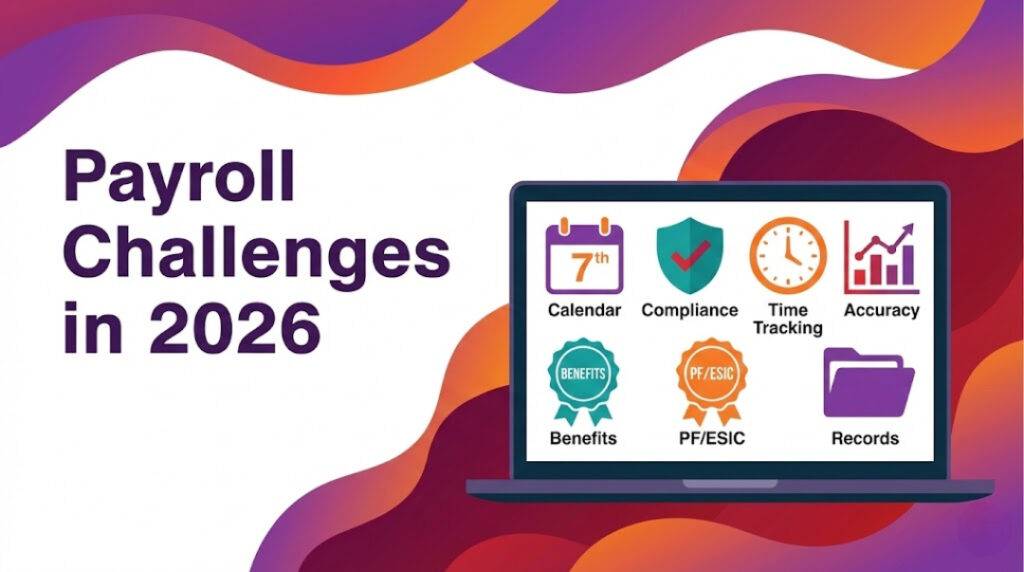
Payroll in 2026 will feel less like a routine monthly task and more like a structured compliance function. Employees expect accurate payslips, on-time salary credits, and complete transparency around deductions. At the same time, audits and regulators demand proper records, compliant wage structures, and correct overtime payouts.
Workforce models are also changing quickly. Many organisations now manage a mix of permanent employees, fixed-term hires, contractors, and gig workers. Each category follows different rules, benefits, and documentation standards. As a result, payroll is no longer just about calculations, it depends heavily on process discipline, coordination, and communication.
This article outlines the most common payroll challenges HR teams will face in 2026 and shares practical ways to reduce errors, stay compliant, and maintain employee confidence.
Why Payroll Is Becoming More Difficult in 2026
Compliance Pressure Is Increasing
India’s labour framework is steadily pushing organisations toward clearer wage definitions, stronger documentation, and stricter timelines. Informal practices such as delayed salary payments or loosely tracked overtime now carry higher risk.
Payroll today is closely tied to compliance, not just administration.
Multiple Workforce Types Add Complexity
A blended workforce creates multiple payroll paths. Fixed-term employees, contractors, and gig workers all come with different expectations and legal considerations. If worker classification or documentation is unclear, payroll errors become unavoidable.
This growing complexity is one reason many organisations choose to outsource payroll services instead of managing everything internally.
Employees Expect Transparency
Employees are far more aware than before. They question salary structures, PF calculations, and deduction changes. When payroll teams cannot explain these clearly, trust erodes quickly.
Accuracy alone is no longer enough, clarity matters just as much.
The Biggest Payroll Issues in 2026 : How to Fix Them
1) Wage structure: the 50% rule, stated correctly
This is the change most often reported inaccurately, and payroll teams are being asked about it by employees who have read the inaccurate version.
What the Code says. Under section 2(y) of the Code on Wages, 2019, basic pay plus dearness allowance plus retaining allowance must together be at least 50% of total remuneration.
What it is usually reported as. “Basic salary must be at least 50% of CTC.” That differs in two ways: it is three components rather than basic alone, and it is measured against total remuneration as the Code defines it rather than against cost to company, which typically includes employer PF and gratuity provisioning.
There was also no earlier statutory rule fixing basic at 30%. That figure was common practice, not a repealed provision, so describing the change as “30% to 50%” is misleading.
Why it still matters. The effect is real even if the framing is wrong. Structures built to suppress basic and inflate allowances no longer work, and because PF and gratuity are both calculated on basic plus DA, correcting a structure raises both.
How to handle it:
- Model the PF and gratuity cost before changing any structure.
- Correct forward. Apply the revised structure to new hires and increments rather than reducing a component an existing employee already receives.
- Update the appointment letter template and the salary annexure at the same time, not later.
- Brief whoever answers payslip questions, because employees are arriving with the incorrect version.
Two related deadlines worth checking while you are in there: wages are due by the 7th of the following month, and final settlement within two working days of an exit.
2) State-wise minimum wage alignment
Minimum wages vary by state, skill level, and industry. For multi-location organisations, this is a frequent source of payroll errors.
How to overcome it:
- Maintain a state-wise minimum wage tracker
- Map roles accurately to wage categories
- Keep a compliance reference file for each state
- Update salary offers before payroll processing
3) Overtime rules and working-hour limits
Overtime expectations now include double pay beyond eight hours a day and tighter weekly limits, usually forty-eight hours. Informal “stay back” culture becomes expensive if not tracked properly.
How to overcome it:
- Set a clear overtime approval workflow
- Use reliable attendance and time-tracking systems
- Train managers to treat overtime as a cost and compliance issue
- Review overtime data monthly
4) Salary credit deadline by the 7th
With salary payments expected by the 7th, delays in attendance or approvals can derail payroll cycles.
How to overcome it:
- Lock attendance by the 1st or 2nd
- Freeze payroll changes after a defined cut-off
- Push early submission of variable pay inputs
- Follow a fixed payroll calendar every month
5) Social security expectations across worker categories
There is increasing focus on extending social security benefits to more worker types. Even when eligibility differs, confusion often leads to disputes.
How to overcome it:
- Clearly classify worker categories
- Maintain proper contracts and documentation
- Communicate applicable benefits upfront
- Keep records ready for audits
This is another area where organisations often decide to outsource payroll services to ensure correct classification and documentation.
6) Unauthorised deductions and payroll disputes
Unexpected or unexplained deductions are a major trust-breaker.
How to overcome it:
- Create a clear deductions policy
- Ensure every deduction has approval and proof
- Provide easy-to-read payslips
- Set up a structured payroll query resolution process
7) TDS declarations and year-end pressure
Late tax declarations create last-minute corrections, impacting take-home pay and increasing complaints.
How to overcome it:
- Start declarations early in the financial year
- Track missing submissions monthly
- Set proof deadlines before January
- Communicate the impact of delays clearly
8) Attendance and leave mismatches
Many payroll errors stem from mismatches between attendance data and leave approvals.
How to overcome it:
- Standardise leave approval timelines
- Use one verified source of attendance data
- Reconcile leave and attendance before payroll freeze
- Encourage quick correction requests
9) Faster exits and full & final timelines
With expectations shifting toward completing full & final settlements within two working days, slow clearance processes create serious risk.
How to overcome it:
- Use a structured exit checklist
- Standardise F&F calculation templates
- Clearly document recovery rules
- Ensure all exit data is ready before the last working day
10) Audit-ready payroll records
In 2026, compliance requires proof. Records for attendance, overtime, salary structures, and statutory contributions must be maintained properly.
How to overcome it:
- Maintain monthly payroll folders with checklists
- Store approvals and change records
- Keep salary structures and letters updated
- Conduct quarterly internal payroll audits
A Simple Monthly Payroll Calendar That Works
A consistent payroll calendar reduces stress:
- 1st, 2nd: Attendance locked
- 3rd, 4th: Draft payroll prepared
- 4th, 5th: Reviews and approvals
- 6th: Payroll freeze
- 7th: Salary credited
- 10th, 12th: Payslips shared
- Before 15th: PF/ESIC challans prepared
- As per due dates: PT, LWF, and other filings
Predictability is key to payroll stability.
Quick Payroll Controls HR Can Apply Immediately
- A clear payroll cut-off policy
- Monthly approval and exit checklists
- A payroll query tracker with timelines
- Quarterly compliance reviews
- Centralised attendance and document systems
Consistent controls prevent most payroll issues.
Conclusion
Payroll in 2026 is no longer just about calculations it requires accuracy, structure, and strong governance. It impacts compliance, cash flow, employee trust, and overall employer reputation. Most payroll challenges arise from gaps in processes and coordination, not the numbers themselves. By implementing clear calendars, standardized documentation, and proper review controls, businesses can manage payroll more effectively.
To support this, many organizations are adopting modern HR solutions that integrate payroll with compliance and workflow management. For teams with limited capacity, outsourcing payroll services can significantly reduce operational strain while improving consistency and accuracy.
Providers like HRTailor offer comprehensive HR solutions, helping businesses standardize salary structures, automate HRMS driven processes, and simplify payroll operations while still allowing employers to maintain control over statutory payments and key decisions.
Frequently Asked Questions
What are the biggest payroll challenges in 2026?
Keeping up with statutory changes, ensuring accurate calculations, and filing on time.
How can HR reduce payroll errors?
Automate calculations, reconcile data, and use one source for attendance and payroll.
Should payroll be outsourced to avoid these challenges?
For many SMEs yes, since it reduces compliance risk and saves time.
FAQs
Late attendance cut-offs, unclear deductions, inconsistent overtime tracking and poor documentation are the most common issues. These create disputes and compliance risk.
Because the new labour codes make timely salary payment mandatory, with the 7th set as the expected deadline. Delays now increase compliance risk and directly impact employee trust.
Overtime should be approval-based, recorded properly, and paid at double the normal rate beyond daily limits, while also respecting weekly hour caps.
By providing clear payslips, explaining deductions, using consistent policies and closing payroll queries within a defined timeline.
Different minimum wage rates, local compliances, and state-specific rules on payroll-related items make it harder. That’s why state-wise checklists and periodic reviews matter.
Start with salary timelines, attendance accuracy, wage structure compliance and overtime controls, because they impact both compliance and daily employee trust.
- Payroll outsourcing in India
- Top 10 payroll outsourcing companies in India (2026)
- HR outsourcing services
Related guides
Get a payroll quote →Build a Labour-Codes-compliant salary structure in minutes - Basic, HRA, PF, ESIC and take-home, auto-calculated.
Get it free →